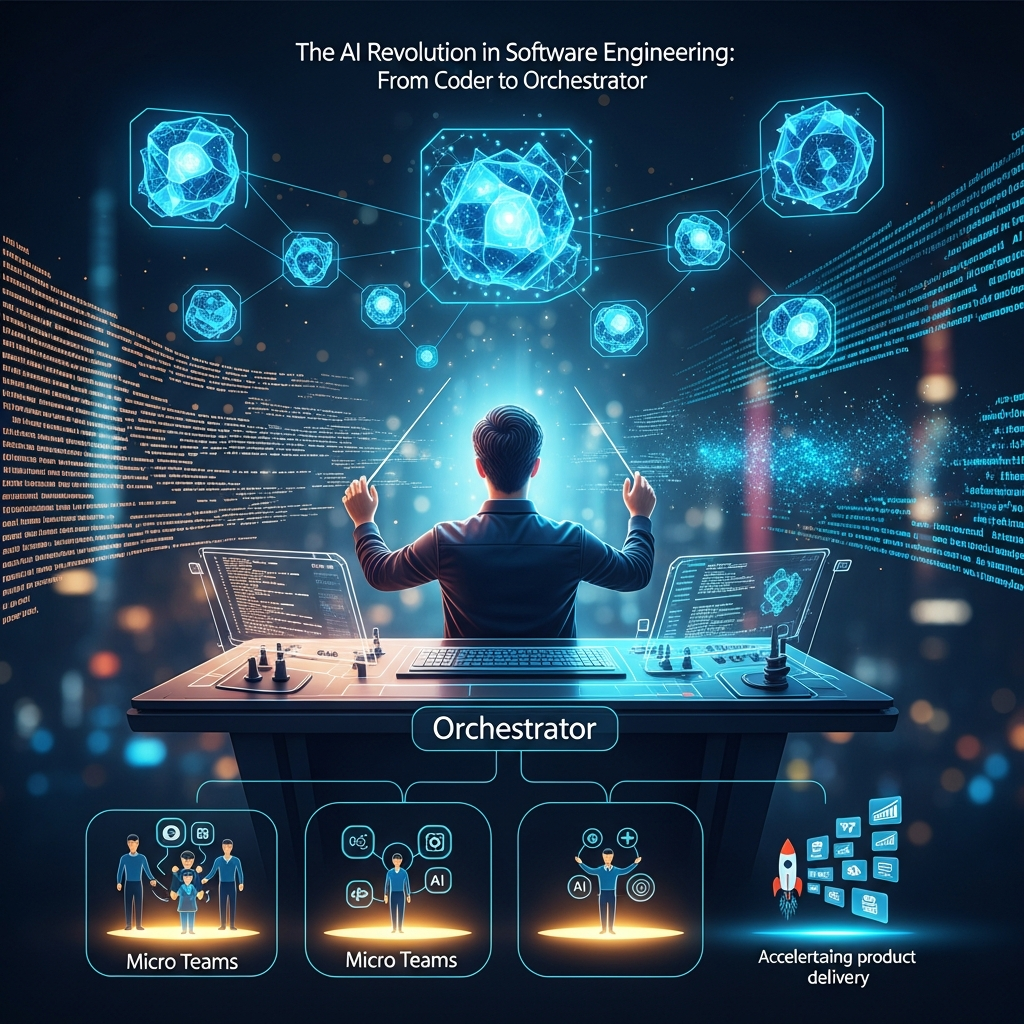
The software engineering world is undergoing an exhilarating and profound transformation. The rise of AI coding is not just automating tasks; it's fundamentally redefining the role of the developer, moving us into an era where human ingenuity is amplified by intelligent agents. If you're a software engineer, or managing a team in this space, get ready for a significant shift: from being a primary coder to becoming a strategic orchestrator of AI.
The Evolving Role: From Crafter to Conductor
The days when writing lines of code was the chief bottleneck in the software development lifecycle are fast becoming a distant memory. AI coding agents are already generating a substantial portion of code—often 60% to 80% in many enterprises, and astonishingly, up to 97.3% internally at leading AI companies. This dramatic change means our core responsibility as developers is no longer just crafting code, but rather supervising, constraining, and reasoning about AI-generated code.
We are no longer merely "crafters of code"; we are becoming orchestrators of intelligent agents. This new role demands a refined, strategic skill set:
- Prompt Engineering: The art of effectively communicating with AI agents to guide precise code generation.
- Agent Behavior Understanding: Comprehending how AI agents operate, their capabilities, and, crucially, their limitations.
- Reliability and Failure Analysis: Proactively identifying potential risks and understanding the failure modes of AI-generated output.
- Debugging and Evaluation: Proficiently debugging AI agents and rigorously evaluating the quality and relevance of their results.
- Data Literacy, Safety, and Security: A strong grasp of data principles, security best practices, and ethical considerations inherent in AI-driven development.
- System Orchestration: Managing and coordinating multiple AI agents in parallel within complex cloud environments.
Embracing an "AI-first" approach and training on higher levels of abstraction, such as model-based software development, is no longer optional; it's a fundamental shift in mindset.
The Enduring Vitality of Human Expertise: Knowledge Base and Infrastructure
Despite the increasing autonomy of AI agents, the human element—the "crafters of code" of the past—remain more vital than ever. Why? Because AI agents, while powerful, lack true comprehension and contextual understanding without human guidance. Our deep-seated knowledge of existing codebases, architectural patterns, business logic, and operational nuances is indispensable for:
- Training and Fine-tuning: Providing the high-quality data and feedback necessary to train AI models, ensuring they generate accurate and relevant code that aligns with our specific needs.
- Establishing Standards: Defining the coding standards, best practices, and architectural principles that AI agents must adhere to.
- Contextual Understanding: Imbuing agents with the necessary context about complex systems, dependencies, and potential risks that only human experience and intuition can provide.
- Infrastructure Knowledge: As AI agents become deeply integrated into enterprise platforms like Microsoft Fabric and AWS Bedrock AgentCore, they rely heavily on robust cloud infrastructure. Developers with expertise in these areas are crucial for ensuring agents are deployed, managed, and operate efficiently within our existing technological landscape. This includes understanding CI/CD pipelines, deployment strategies, monitoring tools, and security protocols, all of which become critical as the volume of AI-generated code escalates.
Our historical knowledge and understanding of the underlying infrastructure are the bedrock upon which AI agents can effectively build and operate.
The Rise of Micro Teams and Accelerated Product Delivery
The advent of AI coding agents is ushering in an exciting new organizational model: the "micro team." Imagine a team of just two human developers, augmented by a dedicated team of AI agents. In this setup, human developers transcend traditional coding, acting instead as strategic managers and architects, leveraging AI agents to handle much of the repetitive code generation and even proactive bug detection.
This powerful synergy leads to an unprecedented acceleration in product feature delivery:
- Faster Code Generation: With AI handling 60-80% of the code, the time spent on initial coding is drastically reduced, allowing teams to move faster than ever before.
- Shifted Bottlenecks: The primary bottlenecks are no longer coding itself, but rather critical stages like planning, design, testing, and review—areas where human creativity, critical thinking, and validation are paramount. By optimizing these processes, the overall development cycle can be streamlined significantly.
- Increased Throughput: Companies embracing AI coding tools are reporting double the pull request throughput compared to those with low adoption, indicating a substantial boost in development velocity.
- Proactive Quality Assurance: AI-powered tools can proactively identify and resolve up to 60% of bugs and quality issues as code is being written, building confidence and sustaining rapid development by preventing problems before they grow.
In essence, the new age of software engineering with AI coding positions developers not as obsolete relics, but as empowered orchestrators, strategic thinkers, and crucial knowledge guardians. Our ability to guide, validate, and manage AI agents, coupled with our deep infrastructure and domain knowledge, will be the true differentiator for companies seeking to deliver innovative products at an unprecedented pace. The future of software engineering is collaborative, intelligent, and, most importantly, human-centric, with AI acting as a powerful amplifier of our ingenuity.
Comments & Discussion
Comments powered by GitHub Discussions. If comments don't load, please ensure:
You can also comment directly on GitHub Discussions