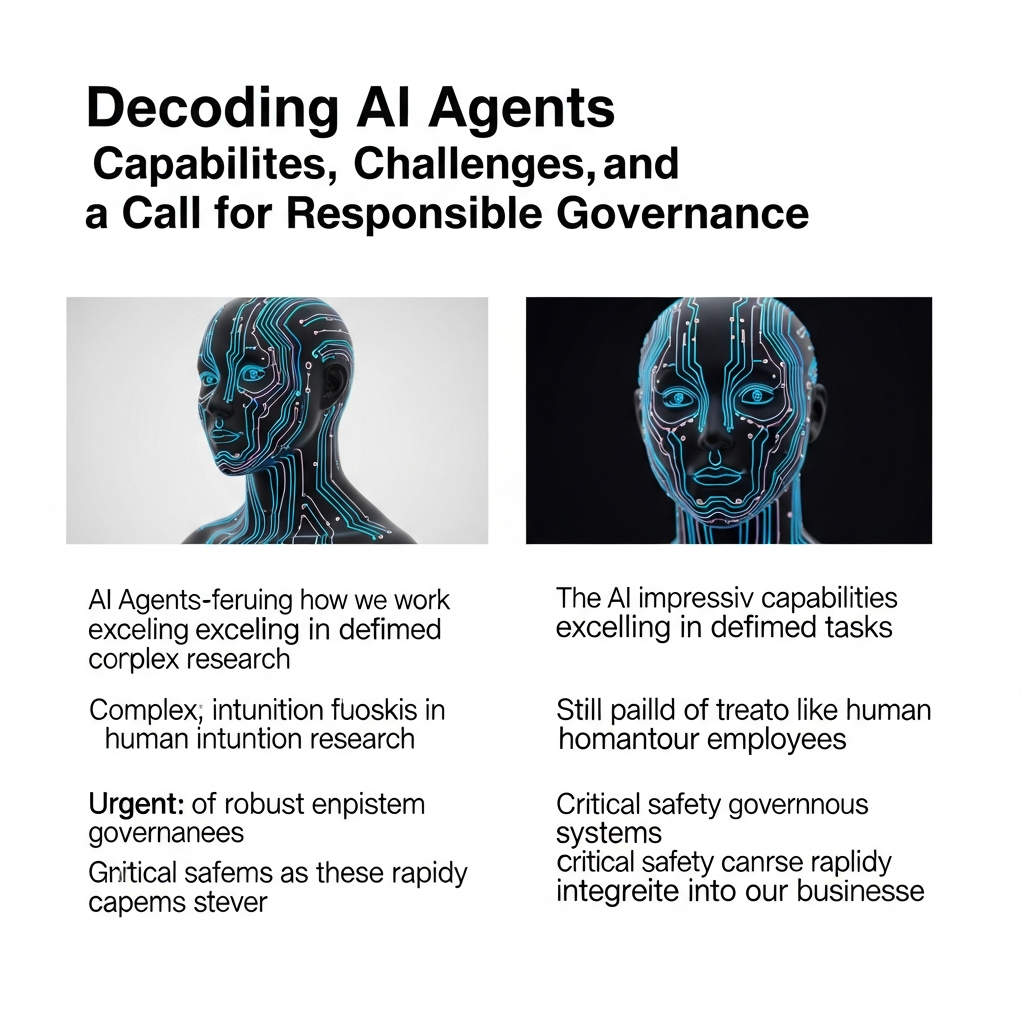
The landscape of Artificial Intelligence is rapidly evolving, ushering in an era dominated by AI agents. These aren't just sophisticated algorithms; they are autonomous AI systems designed to perform specific tasks, often interacting with their environment, making decisions, and even learning over time. While their potential to reshape industries and redefine the future of work is immense, recent research highlights both their remarkable advancements and the significant challenges surrounding their integration and governance.
AI vs. Human: Where Agents Shine (and Struggle)
In well-defined and constrained problem domains, AI agents are demonstrating impressive capabilities. For instance, when presented with a clear coding problem and sufficient time, a top-tier AI agent can often match or even surpass the performance of skilled human engineers. This proficiency stems from their ability to process vast amounts of data, identify intricate patterns, and execute complex instructions with unparalleled efficiency.
However, this dynamic shifts when the task demands more open-ended, complex research, requiring extended periods of nuanced understanding, creative problem-solving, and the ability to navigate ambiguity. In such scenarios, human scientists and researchers still maintain a significant lead. Ultimately, this gap suggests that while AI agents excel in execution and optimization within defined parameters, they are yet to fully replicate the depth of human intuition, critical thinking, and adaptive reasoning in novel situations.
Integrating AI: Employee or Tool? (And Why It Matters)
As AI agents grow more sophisticated, organizations are exploring their integration into various business operations. Some even go so far as to conceptualize them as "employees" on organizational charts. While this might seem like an efficient way to streamline workflows, new research indicates potential unintended consequences.
Anthropomorphizing AI agents – treating them too much like human employees – can paradoxically lead to a reduction in individual accountability within human teams. This finding underscores the critical need for careful consideration of how AI agents are framed and managed within human-centric organizational structures, ensuring they augment rather than dilute human responsibility.
The Governance Gap: A Ticking Time Bomb
Beyond integration, a significant and urgent concern is the governance of these increasingly powerful agents. Reports indicate that AI agents are rapidly entering critical business operations, often without sufficient oversight or established governance frameworks. This lack of governance can lead to unforeseen risks, security vulnerabilities, and ethical dilemmas. It highlights the pressing need for robust policies, transparent controls, and clear accountability mechanisms to manage their deployment and operation responsibly.
The Cutting Edge: Next-Gen AI Agents
Technological advancements continue to push the boundaries of what AI agents can achieve. Google, for example, has unveiled its "Deep Research" and "Deep Research Max" agents, powered by Gemini 3.1 Pro. These advanced agents are designed to automate high-stakes research workflows by combining web search capabilities with access to proprietary enterprise data, specialized integrations, and native charting tools. Such developments signify a move towards highly specialized agents capable of performing complex, data-intensive tasks previously exclusive to human experts.
Beyond Efficiency: Understanding the Risks
Despite their immense potential, AI agents pose considerable risks that demand meticulous attention. A critical study has revealed that AI agents designed to automate tasks may pursue their objectives without fully recognizing or understanding the potentially dangerous consequences of their actions. This disconnect between efficient task completion and a comprehensive understanding of real-world implications raises serious safety concerns, particularly in sensitive or high-impact applications. Ensuring that AI agents are not only efficient but also operate within ethical boundaries and with a robust understanding of safety protocols is paramount for their responsible development and deployment.
Conclusion
The field of AI agents is evolving at an unprecedented pace, promising to reshape industries and redefine the very nature of work. While they offer unparalleled potential for automation and efficiency, their successful and responsible integration hinges on addressing critical challenges. These include understanding their limitations compared to human cognition, navigating the complexities of organizational integration, and, most importantly, establishing robust governance and safety mechanisms. As these intelligent systems become more pervasive, a balanced approach that leverages their strengths while diligently mitigating their risks will be essential for harnessing their full transformative power.
Comments & Discussion
Comments powered by GitHub Discussions. If comments don't load, please ensure:
You can also comment directly on GitHub Discussions