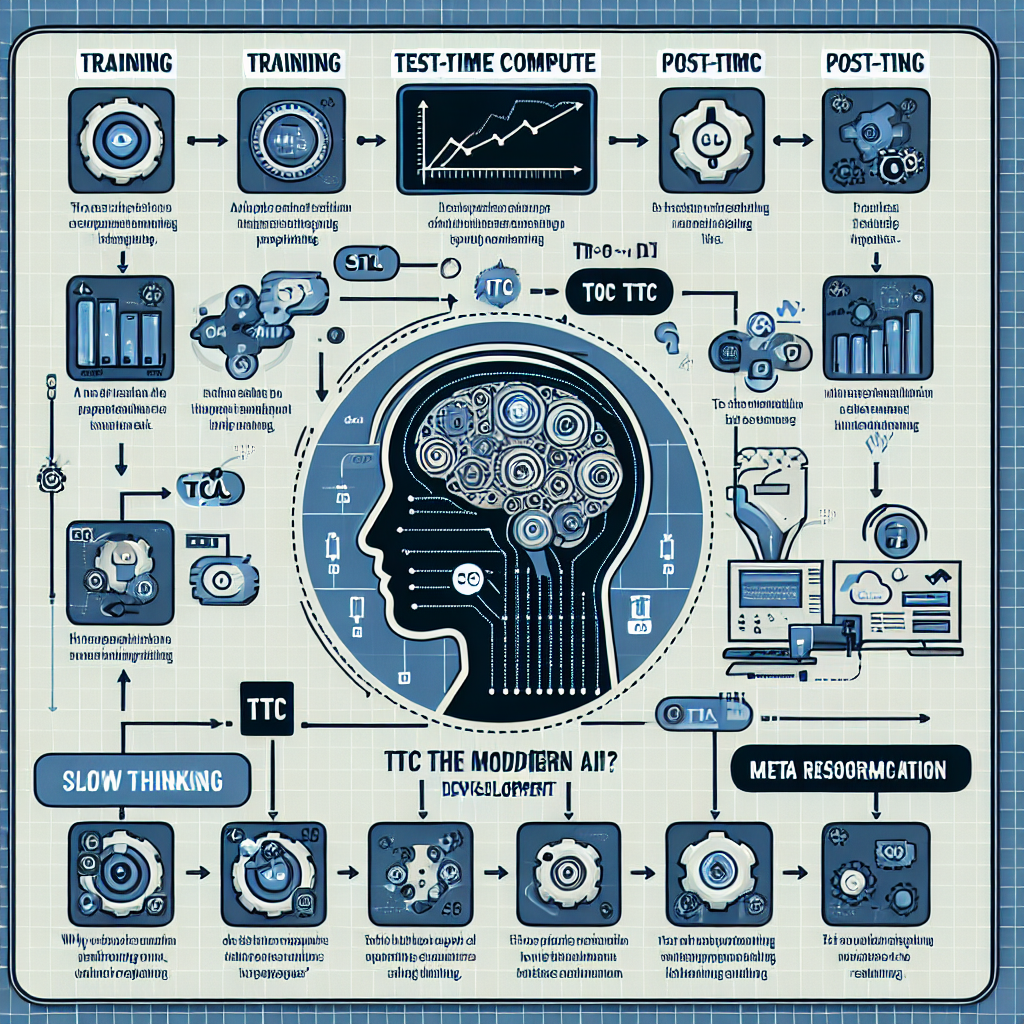
The Hidden Cost of AI Smarts: Diving into Test-Time Compute
We hear a lot about the massive computational power needed to train cutting-edge AI models like GPT-4. Training compute is staggering, involving vast datasets and powerful hardware running for weeks or months. But what happens after the training wheels come off? How much power does it take for that trained model to actually answer your question, generate text, or analyze an image?
This is where Test-Time Compute (TTC) comes in. Also known as inference compute or inference cost, TTC refers to the computational resources (processing power, memory, time) consumed when a trained model makes predictions or generates outputs on new, unseen data. It's the cost of using the AI, and it's rapidly becoming one of the most critical factors in modern AI development and deployment.
While training compute grabs headlines, TTC dictates the real-world viability, user experience, and economic feasibility of AI applications.
From Afterthought to Bottleneck: The Rise of TTC Importance
In the early days of machine learning, models like linear regressions or simple neural networks were computationally light during inference. TTC was minimal, often overshadowed by the challenges of gathering training data or tuning parameters.
The game changed with Deep Neural Networks (DNNs). As models for image recognition (like ResNet) grew deeper, inference latency started to matter, especially for real-time applications.
Then came the Transformer era. Models like BERT, GPT-3, and their successors exploded in size, often boasting hundreds of billions or even trillions of parameters. Training them is an epic undertaking, but deploying them efficiently presents an equally daunting challenge. The sheer size of these models means their TTC is substantial.
Why does this matter so much now?
- Latency: Users expect near-instant responses from AI applications like chatbots or search engines. High TTC makes achieving the desired sub-second latency a major hurdle. Delays over 500ms can feel sluggish and degrade the user experience.
- Throughput: TTC determines how many users or requests a deployed model can handle simultaneously, directly impacting its scalability.
- Cost: Running large models, especially on cloud platforms, incurs significant operational expenses, largely driven by inference compute. Optimizing TTC is vital for economic sustainability.
- Energy Efficiency: The continuous computation required for inference contributes significantly to the energy consumption and environmental footprint of AI systems.
Suddenly, building a powerful model isn't enough. You also need to be able to run it efficiently, affordably, and responsibly.
The "Slow Thinking" Revolution: Trading Speed for Depth
A fascinating trend is emerging: deliberately increasing TTC to unlock higher levels of reasoning and performance. This counterintuitive approach draws parallels to human cognition:
- System 1 Thinking: Fast, automatic, intuitive (like a quick reflex).
- System 2 Thinking: Slow, effortful, logical, step-by-step reasoning (like solving a complex math problem).
Many AI applications prioritize System 1-like speed. However, researchers are finding that allowing models more "thinking time"—more TTC—enables them to tackle complex problems more effectively. Techniques like Chain-of-Thought (CoT) prompting, where models explicitly write out intermediate reasoning steps, inherently increase TTC but often lead to dramatically better results on tasks requiring logic and planning.
Models like OpenAI's conceptual "o1" and DeepSeek's DeepSeek-R1 exemplify this shift. DeepSeek-R1, for instance, uses Reinforcement Learning (RL) techniques during inference to refine its step-by-step reasoning, effectively scaling TTC to boost performance.
Mastering TTC: Techniques for Optimization and Scaling
Research in TTC tackles two main goals: reducing baseline TTC for efficiency and effectively utilizing increased TTC for enhanced capabilities.
Here are some key methods:
- Chain-of-Thought (CoT) / Step-by-Step Reasoning: Intentionally structuring prompts or model outputs to include intermediate steps, using more compute for better reasoning.
- Test-Time Training (TTT): Allowing the model to continue adapting or fine-tuning itself based on the specific data it encounters during the inference phase.
- Reinforcement Learning (RL) for Inference: Using RL to guide the model's generation process at test time. This can range from basic outcome-based rewards to more sophisticated methods.
- Meta Reinforcement Fine-Tuning (MRT): An advanced RL technique proposed in recent research (arXiv:2503.07572). MRT formalizes TTC optimization as a meta-RL problem, viewing the output generation as a series of steps. It uses a dense reward signal measuring "progress" towards the correct answer at each step, helping the model better balance exploring different reasoning paths versus exploiting known good ones. This approach has shown significant performance and efficiency gains, particularly in math reasoning tasks.
- Search Algorithms: Integrating methods like Monte Carlo Tree Search during inference allows models to explore multiple potential solution paths before selecting an answer.
- Retrieval Augmentation: Equipping models with the ability to search for and incorporate external information during inference (like the "Search-o1" concept) adds compute but can ground responses and improve accuracy.
- Traditional Optimization: Standard techniques like model compression (quantization, pruning), knowledge distillation, and hardware acceleration (GPUs, TPUs) remain crucial for reducing the fundamental TTC of any given model.
The Balancing Act: Challenges and the Future of TTC
The core challenge lies in the trade-off: boosting model capability via increased TTC often comes at the cost of higher latency, increased operational expenses, and greater energy use.
The focus, therefore, is shifting towards compute efficiency: getting the maximum reasoning improvement per unit of TTC. Techniques like MRT are promising steps in this direction.
Making these advanced TTC optimization and scaling methods accessible beyond large, well-funded labs is another hurdle.
Despite the challenges, optimizing and strategically scaling test-time compute is viewed by many experts as a critical frontier in AI. Some even suggest it could be as transformative as the Transformer architecture itself. Why? Because TTC directly governs how the most powerful AI models translate their potential into tangible, usable, and economically viable real-world applications.
As models continue to grow and our expectations for AI reasoning deepen, mastering the art and science of test-time compute will be paramount. It's no longer just about training the smartest model; it's about enabling that model to think effectively and efficiently when it truly matters.
Comments & Discussion
Comments powered by GitHub Discussions. If comments don't load, please ensure:
You can also comment directly on GitHub Discussions