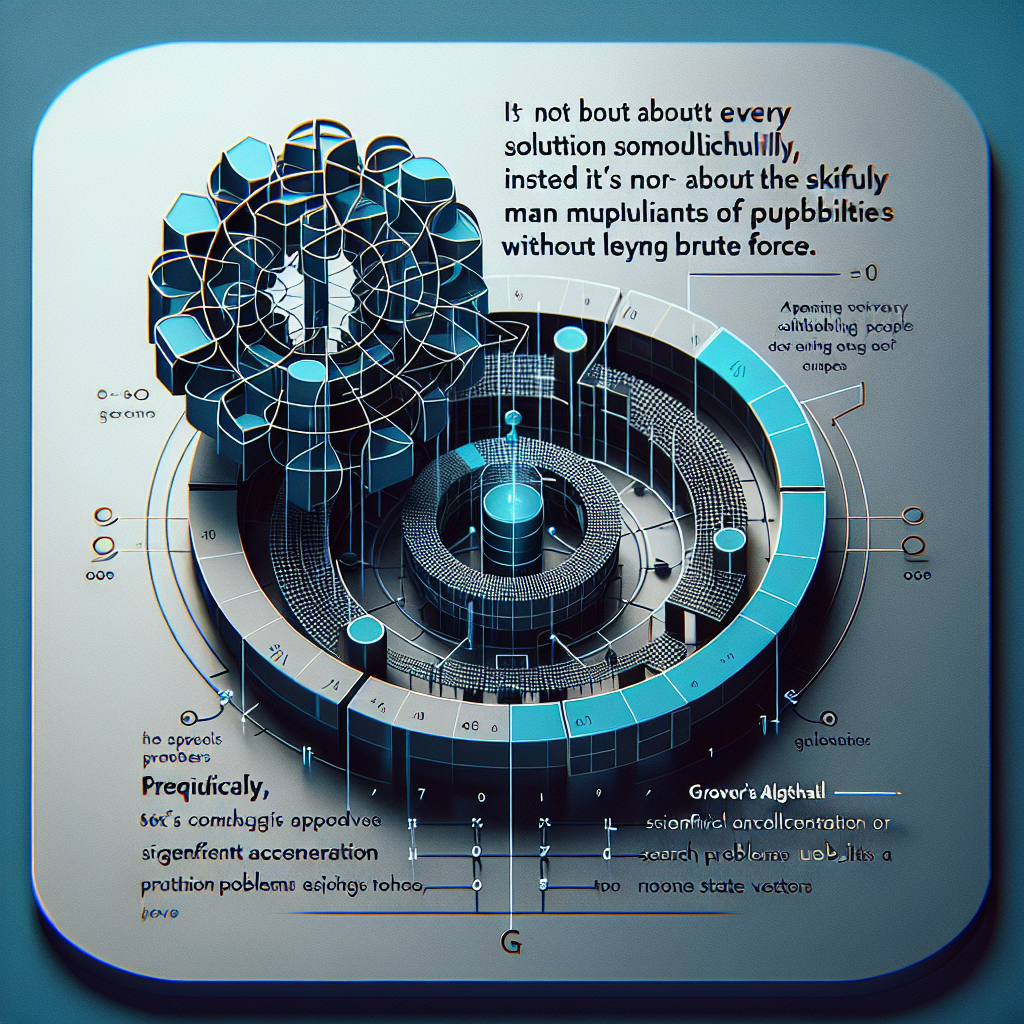
Quantum computing is a hot topic, promising groundbreaking advancements across various fields. However, pop science often simplifies its concepts, leading to significant misconceptions. While it's true that quantum computers leverage the strange rules of quantum mechanics, they don't work by simply trying every possible solution simultaneously.
Bits vs. Qubits: A Fundamental Difference
Classical computers rely on bits, which represent either a 0 or a 1. They process information sequentially based on these binary states. Quantum computers, on the other hand, use qubits. Unlike bits, qubits can exist in a state of superposition, meaning they can represent a combination of both 0 and 1 simultaneously.
This ability for qubits to be in multiple states at once is powerful, but it doesn't mean a quantum computer instantly checks every possibility in parallel. Instead, the power lies in the computer's ability to hold and manipulate the probabilities of different outcomes.
The State Vector: Encoding Probabilities
The state of a quantum computer isn't a simple list of 0s and 1s. It's described by a state vector, a mathematical representation that encodes the probability amplitudes for measuring the system in any of the possible classical states. Think of probability amplitudes as related to the likelihood of observing a particular outcome when the quantum computation finishes.
Quantum programs are essentially sequences of operations (quantum gates) designed to carefully manipulate this state vector. The goal is to steer the computation so that the probability of measuring the correct output is significantly increased, while the probabilities of incorrect outputs are diminished.
Grover's Algorithm: Searching Smarter, Not Harder
One of the most well-known examples of a quantum algorithm is Grover's algorithm. It's designed to solve the problem of finding a specific item in an unsorted database or list of N items. This is often called the "needle in a haystack" problem.
Classically, finding this item requires checking, on average, about N/2 items. In terms of computational complexity, this scales linearly with the size of the list, denoted as O(N).
Grover's algorithm offers a significant speedup. It can find the target item in approximately O(\u221aN) steps. This is a quadratic speedup. It's crucial to note that this is not an exponential speedup like the one provided by Shor's algorithm for factoring numbers.
Debunking the Brute-Force Myth
The common misconception about Grover's algorithm is that it finds the item by somehow checking all possibilities simultaneously. This is incorrect.
Instead, Grover's algorithm works by cleverly manipulating the probability amplitudes associated with each possible state (each item in the list). Through a process called amplitude amplification, it repeatedly increases the probability amplitude of the target item's state while decreasing the amplitudes of all other states. Geometrically, this can be visualized as rotating the state vector closer and closer to the desired target state within a high-dimensional space.
After a specific number of iterations (related to \u221aN), measuring the quantum computer's state has a very high probability of yielding the target item.
Why the Quadratic Speedup Matters
While not exponential, a quadratic speedup is still incredibly valuable, especially for large datasets. For a database with a million entries (N=10^6), a classical search might take around 500,000 steps. Grover's algorithm could potentially find the item in around \u221a1,000,000 = 1,000 steps. That's a considerable difference!
Furthermore, the search problem tackled by Grover's algorithm serves as a template for a vast array of problems in computer science. Many problems in the NP class (problems whose solutions can be quickly verified, even if finding them is hard) can be framed as search problems. Grover's algorithm provides a universal method for obtaining a quadratic speedup for these types of problems.
The True Power of Quantum Computation
Quantum computing's potential doesn't come from a magical ability to try everything at once. Its power lies in harnessing quantum phenomena like superposition and interference to manipulate the probabilities of potential outcomes. Algorithms like Grover's demonstrate how this can be used to efficiently guide computation towards a desired solution, offering significant speedups for specific, but broadly applicable, problem types.
Understanding this nuance is essential to appreciating the real challenges and exciting possibilities of the quantum era.
Comments & Discussion
Comments powered by GitHub Discussions. If comments don't load, please ensure:
You can also comment directly on GitHub Discussions